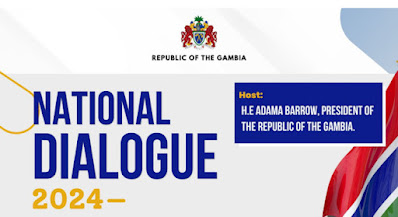
Alagie Barrow urges new paradigm shift to tackle crime rates
The Outpost is an online publication of news, opinion and civic education content on pertinent issues which are of importance, significance and public interest to The Gambia and her Citizens.
Team Outpost
Alagie Saidy-Barrow, former TRRC Investigator has called on the government of President Adama Barrow to take a new paradigm shift towards tackling crime rates in the country.
In his regular contribution on Coffee Time show on Tuesday, he said keeping data on crime will help reduce the high rate of crimes in the country.
“Keeping statistic on crime is critical in internal security. Not that does this guides authorities or resource allocation, but it also helps with the formulation of crime policies.
Importantly data on crime rates helps with the perception of crime trends,” he said
Statistic on crime and development he said, can be very political.
“We have reduce our security matters into partisan politics. Instead of a holistic debate in crime and its cause and consequences, it becomes an emotionally charged and minds of back of forth without any substance”.
He continued: “given the lack of centralised crime data base. The level of crime in The Gambia becomes a matter of perspectives and not facts.
The safety and security of the people deserves better that that,”
He recounted the number of unaccounted crimes committed during the former government of Yahya Jammeh.
“I remember how so many of my colleagues were shot at the number of an unaccounted when we worked on an enforced Disappearances during the dark days of the APRC government.
We were unable to get any accurate data on the number of Disappearances but we at least manage to lay hands on the files of over one hundred missing persons in The Gambia.
When people think that crime is rampant it creates an atmosphere of fear. And the population leaves in fear of each other. And that in itself creates insecurity,” he said.
Hr added: “our idea of security is limited to thieves not being able to break into our houses, whilst our government central theme is how to maintain their government positions and privileges.
A place is not secure when food is scarce, a person cannot be secure knowing that when they sick they cannot afford good health care. A person cannot be secure when they have no income.
We should take a pause and see who are secure ones among us. They are the very people who claim to be working for us. They are secure but the majority of us are not” he concluded.
By Pa Louis Sambou
For most people, the Israel - Palestine question is probably the one conflict whose ugly scenes of horror has regularly appeared before their screens for a period of time spanning their entire lifetime. Although not the only unresolved historic territorial question, it is certainly the only none-frozen one, which fact probably explains why it evokes strenuous opinion from even folks afar, with Gambians not an exception. Whether pro Israel or pro Palestine, far too many well-meaning people the world over, find themselves holding very strong views on this subject matter, but which position is in most cases predominantly driven and sustained by subjective factors and considerations. A particular news article which I recently came across on a Gambian newspaper, exhibited a spectacular example and presentation of this phenomenon.
Without offering a line by line review of the news article in question, which is definitely not the objective of this article, I will draw out a key substance from it which is of relevance to the question at hand: Comments attributed to the individual named and quoted in the news article states:
“the UK, above all else, must be held responsible for this conflict since they were the colonial power in Palestine and also because they were the ones who granted Palestine as a home for Jews in 1917.”
This claim incorrectly implies that: the respective territories were part of the British empire, and that Jews did not form part of the indigenous population prior to the stated period, and that Palestine was granted to Israel by the UK. However, as is elucidated in the subsequent detail below, there is no credible factual or historical basis to these broad-brush claims.
The United Nations publication, Origins and Evolution of the Palestine Problem: 1917-1947 has it that, following World War 1 (WW1) and the subsequent fall of the Ottoman Empire in 1922, the Middle East territories which the Ottomans controlled, came under British and French control. Effectively, the territories which today constitute Israel and Palestine, were under British control as part of this arrangement which rather than being colonialism in the name of the British Crown, was a mandate which had the support and formal approval of the League of Nations (subsequently the United Nations). In view of these historical facts, in addition to the claim that Palestine was a British colony being historically inaccurate, it considerably misconstrues the nature of British colonialism, and inadvertently downplays the adversities suffered by, and does injustice to parts of the world which were arbitrarily occupied in the name of the British Crown and subject to the control of its imperial authority without the benefit of an international instrument, and a third party arbiter such as the League of Nations as was the case with the Palestine British mandate. Furthermore, without taking too much of a pivot away from the subject, it is of historical relevance to elaborate on the backdrop against which this arrangement emerged: WW1 broke, and the Allied European powers, Britain, France and Russia sought to defeat the Central powers (Germany, the Ottoman Empire, the Austro Hungarian Empire and Bulgaria) with whom they were at war, and on the other hand, the Arabs who were under the colonial subjugation of the Ottoman Turks, wanted Arab independence. This was especially so, following the coup in 1908 by the Young Turks (also the perpetrators of the Armenian genocide) who subsequently embarked on a Turkification policy throughout the Ottoman Empire which policy most Arabs felt threatened their distinctive cultures. It was against this backdrop that the Arabs in the Ottoman Empire and the European Allied powers conspired to pursue their mutual interests of bringing the Ottoman Empire to its knees, subsequently giving rise to everything else which followed including the emergence of new Arab countries and monarchies as exists today. So, contrary to what the news article in question implies, rather than a coloniser, Britain was a strategic collaborator (with the respective Arab figureheads) against the Ottoman Turks’s colonial interests and ambitions.
In addition to the above, according to the Institute for Palestine Studies, in the first century after the Ottoman conquest of the territories, the Jewish population in Jerusalem “dropped from 1,330 in 1525 to 980 in 1587”. The same source also details that, when the Ottomans designated the three districts of Palestine, although the majority of its 600,000 inhabitants were Muslims, and 10% Christians, “25,000 of its inhabitants were Jews”, which historical fact is also consistent with the fact that the territories host historical and spiritual sites which are of significance to Islam, Christianity, and Judaism. As these historical facts abundantly evidence that, the territories have at all material times in historical memory, always been inhabited by Muslims, Christians and Jews, it is therefore entirely inaccurate to suggest that the presence of Jewish people in Palestine (or modern day Israel), is a feature or relic of the historically nonexistent British ‘colonialism’ in Palestine.
For the avoidance of historical doubt, contrary to popular warped belief, the historical facts on World Atlas indicate that no contemporary western power had any colonies in the Middle East (not to be confused with South East Asia), as that part of the world has been under Ottoman rule since around the year 1517, and right through to 1922 when the Ottoman Empire was officially ended, having been defeated alongside its WW1 allies Germany, the Austro-Hungarian empire and Bulgaria.
On the third claim regarding the granting of Palestine to the Jews by the British as the “colonial power”, although a widely held view, this is merely an assumption if not a myth. Britain’s administration of the territories (which constituted modern day Israel, Gaza, the West Bank and modern day Jordan which was carved out as an independent country in May 1946, towards the tail end of the British mandate) was mandated and governed by the League of Nations’ approved mandate for Palestine 1922, Article 2 of which 13 - page international instrument, mandated for the “establishment of a Jewish national home” as follows:
“The mandate shall be responsible for placing the country under such political; administrative and economic conditions as will secure the establishment of the Jewish national home, as laid down in the preamble, and the development of self-governing institutions, and also for safeguarding the civil and religious rights of all the inhabitants of Palestine, irrespective of race and religion.”
Further to the above, the British administration of this mandate ended in 1947, and the successor to the League of Nations (the UN general assembly), passed resolution 181(II) to partition the Palestinian territories and create the State of Israel, which subsequently became a recognised country in 1948. It is therefore entirely inaccurate to characterise the events so as to suggest that “the UK” was responsible for handing over Palestinian land to the Jews for them to establish modern day Israel. No prejudice intended, but quite clearly, the claim in contention could not be further from reality.
The news article went on to quote the author of the inaccurate historical claims, also making reference to the Balfour Declaration as being the authority upon whose basis the State of Israel was created. The declaration is a historical fact, however, it carried no such weight. If it did, then unless it is the author’s claim that the international community was completely unaware of the existence of such declaration, the League of Nations would have had no course to institute the mandate for Palestine in 1922 as set out earlier in this article, nor would the UN have any course to pass resolution 181(II) to create the State of Israel, which it subsequently recognised.
For additional contextual information, I would draw your attention to the armed Zionist groups which emerged and operated within the territories during the time period of the British mandate. These armed Zionist groups did not spare the British, the wrath of their violence and carnage; a significant historic example of such is the 1946 bombing of the King David hotel in Jerusalem by these, which killed and injured British personnel among other innocent victims. So, if the British government indeed acted in cahoots with these, with the objective of “granting Palestine” to them as the news article inaccurately suggests, then the Zionist armed groups (which the British authorities rightly designated as terrorists and pursued accordingly) would certainly not have actively sought to target British interests in Palestine during that period, would they? Surely, the fatal encounters which rout
By Sheriff Saidykhan
Momodou Gassama, of the World Health Organisation (WHO) has said that one in every eight person in the world has a mental health disorder.
He made these remarks on Thursday at a press briefing, held at Kanifing in collaboration with the Ministry of Health on the Mental Health draft Bill.
“Which means one billion of the world population has a mental health disorder” he said.
He said two per cent of the global health ministries budgets are pumped into the mental health disorders.
“All the health Ministries, and compile all their mental health budgets together. Only two per cent of world health budgets goes to mental health disorder.
In some countries it is far less that that. Some 0.5 per cent of their budgets goes into mental health” he revealed.
He added that the world is not doing ‘enough’ to tackle global mental health disorders.
“The world is not doing enough to address the needs. The mental health is high, and the response are slow,”
He said people reeling with mental health disorders lack the services of treatment.
“Fifty per cent of people with chronic mental health disorders, don\
Rev. Fr. Matthew A. Mendy 1984-2024
Late Rev. Fr. Matthew Ambrose Mendy was the son of Ambrose Mendy and Rose Mendy. He was born on 25 October 1984 in the village of Kitty, West Coast Region of The Gambia (the name meaning a gift of God). He received his education from St. James School- Brikama, Presentation of Mary - Brikama, St. Therese’s-Kanifing and St. Peter’s Senior Secondary-Lamin. During his High School Days Matthew exhibited truthfulness and holiness. Due to his peacemaking and preaching shills (sign of been filed with the Holy Spirit) his fellow students and comrades fondly called him ‘Father Matthew’. That name stayed with him all his lifetime. He always demonstrated willingness and dedication to serve the church.
Between 2005 and 2010, he took up the Catholic Priesthood career, had training at St. Paul’s Senior Seminary Sierra Leone, and was ordained a Priest, on 10 November 2012 by Bishop Emeritus Robert Patrick Ellison CSSp. and Late Archbishop Emeritus Joseph Ganda of Sierra Leone. He served at Bwiam as an Assistant to Fr. Sean, St. Martin (Kartong) PP, St. Michael’s (Njongoon) PP and at the Church of the Resurrection (Brikama) PP. He was a renowned priest of truth, justice and preaching unity. He did a specialized training at the Pontifical Urban University in Rome where he obtained Licentiate in Canon Law and a Diploma in Jurisprudence. Rev. Fr. Matthew served the mission with a life of simplicity, spirit of poverty and humility. Truth must-be-told, he was a respectable scholar known to be sociable and compassionate.
The shocking and sudden death of Rev. Fr Matthew Mendy occurred on Monday 15 January 2024 while receiving medical treatment in Senegal. It was a devastating news and emotions were overwhelming.
As a prelude to his funeral, there were a Nine Days Novena Mass and Rosary for God to grant him the fullness of eternal life in heaven. A book of condolences was provided and a Vigil Service at the Church of the Resurrection in Brikama where he served until his death.
The sentiments raised at the Vigil Service were that:
The sad news was heartbroken to his siblings. Fr. Matthew was a pillar of support to his community; he was a man of few words. Rev. Fr. Matthew was gentle and resolute and left an indelible mark on the canvas of the diocese of Banjul ministry. He enriched the lives of those he touched and inspired his fellow brothers in the Chalice treading the path of compassionate leadership. His homilies were an embodiment of theological discourses characterized by eloquent expressions of a compassionate soul. He desired the unity and development of the Parish of The Resurrection Church, (The Parish he served only for 3 months that culminated to his sudden death). Although dead, he remained alive in the hearts of his family members.
Funeral mass at the St. Therese’s Church Kanifing
The Diocese of Banjul, Diocese of Makeni and the Archdiocese of Freetown all mourned Rev. Fr. Matthew A. Mendy.
Present at the Funeral Mass were Bishop Banni Manga of the Methodist Mission, Rev. Cole representing Rt. Reverend St. Arist Kodjo Baiden, Anglican Bishop of The Gambia and Prof. Pierre Gomez, Minister for Higher Education, Research, Science and Technology. Priests, Religious, Lay Faithful, Believes in Christ, Muslim Brothers and Sisters, People of Other Faiths, and People of Goodwill all came for the funeral.
A Hard Sermon delivered by Fr. Joseph Carl Gomez, Parish Priest at St. Peter’s Parish and who doubles as The Gambia Military Chaplain. The demise of Rev. Fr. Matthew was a very sudden event affecting a young, intelligent and highly motivated priest. It aroused much rumors and speculations as it became the death of four Gambian Catholic Priests in under 3 years. Many were asking questions while others were giving Thanks. Yet still, some regretting him not accomplishing one or two things before his death. Both the Laity and priests were guilty of such procrastinations.
The Laity – some individuals pushed and propagated thoughts that were mere character assassination. The Gambian Catholic Priests are equally mortal. Death comes to Priests and the religious whenever the time comes. In the eyes of humankind, it is unpleasant and never desired.
Faith becomes the most needed response when there is such a great lost. There should not be any accusation or blame of irresponsibility.
Admonition to the Priests - There was jealousy as some of the priests were unhappy for his selection for higher studies and even remarked that the deceased was unqualified. It must be told that the criteria for selection of candidates is not always dependent on identifying ‘A’ Grades or ‘9’Grades but rather on the ‘need to be reformed’ and or for preparation as resourceful person. The need to improve on weaknesses may also determine selection of candidate(s).
The Priestly Ministry is a tough task and can be difficult. Avoid Interference between parishes especially if the unique environment of a particular parish is unknown or not taken into consideration. Priests have individual gifts and strength but these are gifts coming from the same source, God the Almighty. It is necessary to be sensitive to others and be prudent to allow each individual to use and develop his own capability at his own space. False accusations and character assassinations are evil. Rumors can be quite dangerous and can potentially cause stress, hypertension and accelerate underlying health issues. Indeed rumors often yield no good other than ‘adding fuel to the fire\
Team Outpost
Hassoum Ceesay, renowned historian and Director General at the National Centre for Arts and Culture said Gambia attained its independence from Great Britain through political mobilisation of political parties led by former President Sir Dawda Kairaba Jawara.
He made these remarks in an interview yesterday with The Outpost Media.
“Independence was basically a political project. Gambia won her independence through political mobilisation, and not through war or massive civil disobedience, it was largely won through political mobilisation” he remarked.
He said the political mobilisation of political parties, played a significant role in the fight for independence.
“The United Party (UP) of Pierre Njie and the Democratic Party of Reverend J.C Faye, the Gambia Muslim Congress of I.M Garba Jahumpa and the People\
By Sheriff Saidykhan
President Adama Barrow called for the preservation of the nation, safeguarding the state and securing the country\
By Sheiff Saidykhan
Alagie Saidy-Barrow, former TRRC investigator has said that the national dialogue is the resemblance to the national think tank.
He made these remarks in his regular contribution on the Coffee Time show with Peters Gomez on Tuesday.
The rationale behind the national dialogue and the national think tank he said, is of two sides of the same coin.
“Some years ago at the height of the euphoria of the first exit of Yahya Jameh. Some genius came with the idea of the national think tank.
I remember how so many people waited to know who will be the individuals selected to be part of this national tink tank.
As usual some among us waited what drive the notion of the think tank.
When I read the concept note of the tink tank, I suspected that it was a vehicle going nowhere and time has proven my predictions right.
Today I wake with another prediction. This national dialogue like the national think tank is also a vehicle to nowhere,” he posited.
He continued: “Yes some people will collect allowances whilst some will laugh all the way to the bank. But as a people, trapped in this colonial space it will not take us closer to nowhere we ought to be” he said.
On Monday President Adama Barrow launched the national dialogue together with the opposition parties at the State House, to discuss the current political status quo of the country with the Theme: “preserving the nation,defending the state and securing our resources”.
Alagie saidy-Barrow said he welcomed the idea of the national dialogue, but further added that its purpose will be defeated.
“So I think dialogue is a good idea. But the good idea can be defeated by those chosen to implement it. Or crush by the procedure they will use to implement the idea” he said.
He added: “Dialogue means nothing when intentions and minds are not align. Dialogue means nothing when words do not match with actions.
Dialogue means nothing when being in power, being in the good books of those or keeping one\
The premise of thought of most fair-minded people is no doubt that, dialogue is always preferable to anything else to the contrary. So, in principle, the concept of a National Dialogue is commendable. However, ‘a “National Dialogue Meeting” to what end?’, is also an equally rational question for any citizen to ask. Well, it is the question for me anyway.
With the exception of one or two whose opening statements touched on public policy subject matters, one would notice that the issues raised by all other opposition party leaders or representatives who spoke during the opening of this National Dialogue Meeting (NDM) are matters which are already within the remit and competence of the Inter Party Committee to address. As the sponsor, President Barrow’s opening remarks and speech was so unhelpfully vague as to the objective, it offered no comforting opening to the enigma at hand. So, with an unclear and undefined objective, one wonders upon what basis and against what measure, success of this NDM is to be assessed. It is certainly not my proposition that this is an omission by design, but it is nonetheless fair to say that it raises a fundamental question: what is the objective of the NDM?
Furthermore, one also notices from the introduction by the host, John Charles Njie, that the NDM initiative is under the Office of the President (OP). So impliedly, it is not under the responsibility and budgetary allocation of any line Ministry or public authority. Effectively, this means that the implementation and funding of any policy proposals (or resolutions as the host referred to them) emerging from such NDM are certainly going to be issues. The OP, like the Office of the VP (OVP), is hardly a line Ministry, and although it has a budget, it is neither in the business of nor designed to implement policy - the failure of the National Think Tank initiative (which was allocated to the OVP in 2017) is a useful case study in this regard. So again, this also raises another fundamental question: Who is responsible for implementation, and what is its public budget?
In addition to being under the OP, the absence of a clear objective, an implementing authority, and a public budget, presents circumstances which arouses reasonable suspicion, that the NDM initiative is likely a strategic mechanism through which President Barrow seeks to pacify the political opposition, and ‘disarm’ or render impotent, legitimate criticism from within the wider civil society movement. In the apt spirit of healthy cynicism, it is not entirely meritless to conclude that perhaps this is the objective after all.
In my humble opinion, public policy aspirations should always be pursued within the framework of lawfully established public bodies and institutions, and through legislation passed by the people’s elected representatives in Parliament. Seeking to do so outside this conventional and accountable set-up is highly unlikely to yield any good outcomes both in terms of substantive results, and financial accountability. In the meantime though, there are pressing overdue priorities to address such as Security Sector Reforms (which has implications on the spike in crime, public confidence in our Armed and security services etc.), transitional justice including the prosecution of Jammeh and co., implementation of the Janneh Commission recommendations (which are currently being watered down and unpicked, and which has implications on the fight against bribery and corruption) and so forth. The government should be getting on with these, and the opposition and civil society should be pressing them on the same. These overdue priorities take precedence over an initiative which constitutes no more than a talking shop, to no end.
Personally, I do not criticise the opposition parties and civil society entities for taking part in the NDM, but having subjected the initiative to the benefit of reasonable rigour and exposure to sunlight, the indications are that their participation is most probably to their’s and the wider public’s detriment. However, assuming the opposition and civil society are minded to sustain their participation, they should seriously consider framing such participation around matters of public interest, not those within the convenient pre-planned talking points and boundaries set by President Barrow, and whose design I doubt the participating opposition parties or civil society entities had any input in beforehand. Otherwise, it stands to reason that the participating opposition parties and civil society entities will run the risk of incinerating their credibility in the eyes of the public.
About the Author
The author is regular columnist contributor to this medium.
Twitter handle: @That_Pragmatist
Publisher’s Note
Views expressed herein are those of the author and do not necessarily represent the views of the publisher. Want to be a contributing author? Please email opmail220@gmail.com
By Sheriff Saidykhan
Dr. Cherno Omar Barry the Deputy Executive Secretary (DES) of the Senegalo-Gambian Permanent Secretariat has said that there\
Release
Over 100 leading figures led by members of The Elders and the Future of Life Institute, have issued an open letter calling on world leaders to take a bold new approach to address ‘catastrophic’ risks to humanity.
The letter states that ‘long-view leadership’ is needed to tackle the ongoing impact and escalating risks of the climate and nature crisis, pandemics, nuclear weapons, and ungoverned AI. It also illustrates that millions of lives and livelihoods are already impacted by these threats and world leaders’ inaction and failure to cooperate will drive humanity toward ‘greater catastrophe’.
The Elders, including Mary Robinson, Ban Ki-moon, Graça Machel, Juan Manuel Santos, Ellen Johnson Sirleaf, together with the president of the Future of Life Institute, Max Tegmark, have been joined by former leaders, Nobel Laureates, scientific experts, youth activists, business leaders, philanthropists and influential figures from across public life to urge decision-makers to embrace long-view leadership.
The letter outlines this term as the “determination to resolve intractable problems not just manage them, the wisdom to make decisions based on scientific evidence and reason, and the humility to listen to all those affected”.
Mary Robinson, former President of Ireland, and Chair of The Elders commented:
“Our world is in grave danger, but with long-view leadership rooted in truth, justice and inclusion, we can still step back from the precipice. This does not mean global decision-makers should neglect the challenges we face today; it means making decisions that go beyond short-term politics and delivering solutions for people struggling now, as well as future generations. This is entirely possible: if nations work together, our best future can still lie ahead of us.”
While the threats outlined in the letter are grave, the Elders and their partners at the Future of Life Institute stress that hope remains for leaders to address the challenges and use this critical juncture to build a better world. They maintain that these risks can be mitigated with international cooperation and political will. The letter calls for urgent multilateral action, highlighting ideas such as financing the transition away from fossil fuels, concluding an equitable pandemic treaty, restarting nuclear arms talks, and building the global governance needed to make AI a force for good, not a runaway risk.
Ban Ki-moon, former UN Secretary-General and Deputy Chair of The Elders added:
\"The range of signatories to this open letter makes clear our shared concern: we need world leaders who understand the existential threats we face and the urgent need to address them. This can only be done through decisive cooperation between nations. We need to revitalise multilateralism for the sake of our common future. This means upholding the international rule of law and being open and accountable for the decisions we must take. When nations work together, these challenges can all be addressed, for the good of us all.”
The letter comes ahead of the Munich Security Conference, where government officials, military leaders and diplomats will meet to discuss international security. With escalating armed conflict across the world and the threat of nuclear weapons being openly raised, the Elders, the Future of Life Institute, and other signatories urge attendees to address these challenges head-on. The letter also calls for international cooperation as preparations continue for September\