Industrial action: COPG to protest, amid unmet demands
The Outpost is an online publication of news, opinion and civic education content on pertinent issues which are of importance, significance and public interest to The Gambia and her Citizens.
|Is here such a thing as Democratic Authoritarianism? Turkey under the Leadership of Recep Tayyib Erdogan|
By Almamy Fanding Taal
On July 9th, 2018, Recep Tayyip Erdogan was inaugurated as the first directly elected President of Turkey with enhanced executive powers following the victory of the Justice and Development Party (AKP) and its Coalition partner the Nationalist Movement Party (MHP) at the snap election that was called and held on 24th June 2018.
That victory brought back to the driving seat the two allied parties that had achieved the most parliamentary seats, the AKP and MHP. Coalition Governments everywhere for the sake of stability and development are party led except in the Gambia, it is the case in Senegal, Germany, and Turkey. In the past eighteen months many things have happened in Turkey and around the world.
President Recep Tayyib Erdogan secured an emphatic win in the Presidential election which was never in doubt. His latest victory gives him a wide mandate and keeps him in power till 2023. Erdogan’s victory implies that Turkey, a strategic leader of the Muslim World and a vital interlocutor between the West and non-westerners, will evolve from a UK Westminster-style parliamentary system to a more US-styled system with a powerful presidential structure, reinforcing the 2017 Constitutional referendum.
With President Erdogan’s victory, voters now clearly support the institutionalisation of a new presidential system and remain hopeful that it will help resolve economic difficulties while advancing reforms. The AKP won because most people, who endured Turkey’s economic woes of the 1990s, conceded that the brittle coalitions of that era were to blame. Turkey’s electorate still indict coalitions with epic economic mismanagement. Those who remember the old, malfunctioning state with trepidation influenced this election outcome.
Under Erdogan, Turkey’s middle class grew strong as well as their standard of living. Demand for better health, education, and housing rose substantially. However, the spectre of long-term debt now haunts the well-being of this burgeoning middle-class consumer base. Nevertheless, there are strong reforms underway in the Turkish economy which could return Turkey to sustainable growth. Recently the world largest airport terminal was opened in Istanbul so was the world largest mosque inaugurated.
These monumental infrastructure developments are delivered alongside a host of mega projects, bridges, and tunnels beneath the breath-taking Bosporus. No doubt the Turkish people will continue demand more institutionalisation and civic development that will strategically steer Turkey’s political milieu over the coming years.
That economic prosperity and democratisation in Turkey have reached great heights positioning the country as a significant player in global affairs and undeniably makes the case that there are alternatives to the Washington Consensus and neo liberal agenda, however where the country will move on from here remains pivotal.
President Erdogan’s government’s urgent challenges and opportunities within the context of the Islamic Ummah remains to fully integrate millions of Syrian refugees, which has thus far been accomplished with textbook efficiency, ease tensions with the EU and North America and intensify Turkey’s promising geo-strategic consolidation towards the Islamic Ummah which currently comprises 57 Muslim countries that stretch across four continents and form an essential artery for international trade via meaningful land and maritime presence.
With the global population share of more than 22 per cent, Muslim countries have 70 per cent of world’s energy resources and 40 per cent of the global raw materials. Therefore, the idea of being one of the global leaders of the Ummah can be forged as an extremely useful tool to maximise the leverage on the numerous bargaining chips possessed by the Muslim states collectively.
In this context, at last UNGA in September 2019 President Erdogan of Turkey, PM Imran Khan of Pakistan and Malaysia have announced the establishment of joint venture for a Television Channel in English to combat Islamophobia around the world and particularly in the global West.
This is a step in the right direction, Qatar, France, Iran, and China have been broadcasting to world in English for a sometime now. It is certainly an effectively communication channel to tell the Islamic story and respond to several misconceptions about Muslims.
By any measure President Erdogan has demonstrated great statesmanship on the global stage over a series of geostrategic matters and has firmly established his leadership credentials of the Muslim Ummah over the years. It is really gratifying to see Prime Minister Imran Khan fully supporting his leadership in a vastly polarised world and in some parts anti-Islamic. The Muslim narratives must be delivered by Muslim leaders like President Erdogan.
Considering the foregoing discussion and to answer the question above it is well to remember that Mahathir Muhammed during his long and eventful leadership of Malaysia was lambasted and called all kinds of names by the western media. Prime Minister Mahathir had recently made a comeback to active politics in Malaysia at the ripe age of 92 because of his venal, corrupt, and incompetent protégé and successor’s mismanagement of the economy.
Therefore, describing a non-western leader as autocratic or illiberal simply means that western commentators have not been engaged as consultants or advisers of these leaders. Beyond that characterising a non-western leader as authoritarian presupposes that there is a single formula for democracy: in the last US Presidential elections, Mrs. Clinton won the popular vote by more than 3 million votes, but Trump was elected President according to the American formula of democracy.
Even in the face of the spectacular success of Singapore, first Prime Minister Lee Kuan Yew was often described as an authoritarian democrat. In the past this vilification against leaders of non-western countries was largely ideological ranging from Marxist Leninist communism to all other progressive forms of organising society different from the Anglo-Saxon model of democracy.
This Eurocentric view of democracy has led some highly respected western scholars like the Japanese American Francis Fukuyama(whose ancestors were kept in internment camps during WWII) to announce the end of history and the last Man following the fall of the Berlin Wall in 1989. The main thesis of this influential article is that a remarkable consensus concerning the legitimacy of liberal democracy as a system of government had emerged throughout the world over the past few years, as it conquered rival ideologies like hereditary monarchy, fascism, and most recently communism.
More than that, however, he argued that liberal democracy may constitute the \"end point of mankind\
By Sheriff Saidykhan & Amadou Manneh
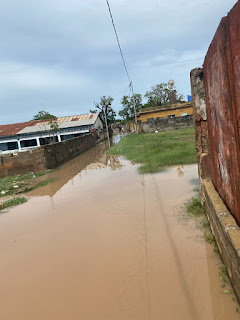
The residents of London Corner especially those near the water-channel have lamented their growing predicaments over access to road in the past two days.
The residents stated that the rain of the past two days have prevented them from going out of their houses.
They also stated that they are finding it difficult to go to the shop or market because the roads are filled with stagnant waters.
They further adduced that, if any heavy downpour occur the water will cause floods in their homes and houses.
Bintou Bah, a resident said the rain of the past two days haven’t flooded in their house yet but it has blocked their roads.
Bintou’s house was flooded in the last August flash flood that caused deaths and destruction across the country.
She said that the water channel has been unsafe for residents to go out and about, because it is dangerous to walk in the potholes fill with dirty waters.
Nyima Barjo another resident in the area said that her grandmother’s house was flooded but it hasn’t cause any damage of properties.
“The problem is that we are finding it difficult to access road to the market or to the shop because all the roads are fill with water,” she said.
She concluded that the road is flooded because the flooding water is not smoothly flooding through the channel. Adding that it rather floods on their roads making it difficult to go out to the market or shop anytime it rains.
By Amadou Manneh
Niger Military Junta is set to charge former President Mohamed Bazoum with ‘high treason’ following his overthrown from office.
The Economic Community of West African States (ECOWAS) in a press statement have condemned the ‘high treason charge’ against Bazoum.
“This is another form of provocation and contradicts the reported willingness of the military authorities in the Republic of Niger to restore constitutional order through peaceful means.
ECOWAS still recognise Mohamed Bazoum as the president of Niger and demanded the military junta to reinstate him to power.
ECOWAS condemns his illegal detention and calls for his immediate release and reinstatement,” the statement said.
In July the military junta of Niger had overthrown the democratic elected government of Mohamed Bazoum causing widespread condemnation from the international community.
ECOWAS imposed sanctions on Niger military junta and further threatened a military intervention if the junta failed to reinstate President Mohamed Bazoum to power after seven days which has now ended.
There is no military intervention yet but ECOWAS has activated a standby force for a possible military intervention. However, series of efforts have been made by the regional bloc, ECOWAS to secure a diplomatic solution to the crisis, but all their efforts still remains unanswered at the borders of inquiry.
By Amadou Manneh
Honourable Halifa Sallah, Secretary General of the People\
“At the beginning, we encountered difficulties in training and identifying players but as time goes on,we started improving by organising friendly matches and training during weekends. The aim of the summer camp is to engage the students,put them together.” said Mr Sherriffo Suso a teacher at ABC school
He made the statement at the opening of a football match at the close of The ABC Schools 5 day Summer Camp between Brikama and Jeshwang Girls Football Academies at Bottrop Football Field on Sunday morning.
Mr Suso who is also a coach of the ABC girls academy, disclosed that the Butterfly Friends conceived the idea of establishing a girls football academy last September primarily to develop soccer skills of girls.
Muhammad Secka ,another Coach of ABC reiterated the initiative of the Butterfly Friends while expressing appreciation for the sponsorship packages in education and Health.
The beneficiary girls academy footballers positively spoke on the fhe impact of the training while describing the summer camp successful.
The football outfits of both academies were provided by the Butterfly Friends.
The highlights of the summer camp also includes singing and dancing
By Pa Louis Sambou
It is certainly neither an inaccuracy nor an exaggeration to state that the Western part of the African continent which is officially known as West Africa, has had, and still experience crises which by any measure, are of far greater magnitude and scope than a coup in the Republic of Niger. Boko Haram terrorists kidnapping innocent schoolgirls, ISIS – inspired jihadist terrorising communities and conquering swathes of territory in the Sahel regions of West Africa, Alpha Condé, Alasan Outtara, corrupting their republican Constitutions, and Mackey Sall corrupting Senegalese democracy to prolong their respective times in office but to name a few of the crises which faced and still face the region, albeit without any serious response from the regional bloc, ECOWAS. However, ECOWAS officialdom wish to have us believe that a bloodless mutiny in Niger which evolved into a military coup, is the gravest West African emergency of our time. Since when is a coup any crisis in West Africa anyway?
Unfortunately, whether cronyism, corruption or coups, although undesirable, the region’s circumstances are such that none of these is as shocking as would otherwise be the case. In fact, it is entirely accurate to venture that, soldiers plotting coups in the name of ‘salvaging the people’ is as normal a day in the office in the career of most soldiers, as is politicians plotting corrupt schemes against their people until they’re eventually ousted through a coup. So let’s be brutally honest here, the tragedy is, cronyism, corruption and coups in West Africa are three problematic phenomena which are so regular, unfortunately, none constitute an extraordinary occurrence anymore.
Notwithstanding all said thus far, if you’re a West African President, successful coup number four in three years will certainly keep you awake at night and understandably so. But such does not elevate this perception of insecurity into an emergency which merits what could only be construed as an overzealous if not a premature seven – days ultimatum by ECOWAS and threat of military intervention in Niger.
The condemnation of the coup in Niger by the regional bloc, is something which merits commendation. But that is as far as any responsible observer’s support ought to go, because the bloc’s threats of military intervention is with all due respect extremely ill-advised in view of what is at stake. Let’s be absolutely clear what we have here: there appears to be no sign of a split in the Niger military, there appears to be no sign of formidable opposition to the coup from among the wider population. So, clearly, any intervening troops are more likely to have lethal hostility visited upon them from even among the civilian population, than being greeted with flowers and kisses. Now, in the absence of any groundswell opposition to the Junta, from both within the military and the civilian population, even if an ECOWAS intervention were to successfully achieve the reinstatement of the deposed democratically elected President Bazoum, realistically speaking, they’ll need to disband what remains of the Military to create a new Military edifice as well as a breed of ‘new loyal citizens’ or in the alternative stay put for an indeterminate period, to deter a subsequent civil uprising. The former is realistically unachievable, and the latter so time consuming and expensive, it is practically unviable. And this is an ECOWAS military intervention’s best case scenario under the circumstances, based on open source information.
It is a common saying within military circles that ‘no plan survives contact with the enemy’.Unless the bloc’s threat relies upon some marvellous genius plan which is capable of dispelling the aforesaid cautionary military adage which is seldom proven wrong, if followed through, it’ll simply invite the opening up of a new frontline on the African continent in the new ‘cold’ war between the West and its Eastern adversaries. Just like was the case in Angola from the mid 1970s, but covering much larger territory and involving multiple countries across the Sahel on this occasion. Effectively, in the unlikely event the bloc acts on its threat, then ECOWAS would have declared war on itself and against the interests of its member states and citizens, and which will significantly intensify irregular migration flows across the Mediterranean into Europe risking much more lives and exposing North Africa and southern Europe to the risk of unprecedented instability. Besides, what’s there to guarantee that such international armed conflict in the Sahel will not spread further north or south?
Furthermore, in view of the fiery reaction to ECOWAS’s threat of military action from the Niger military junta, the juntas in Mali, and Burkina-faso, and the opposition from allies of the junta such as Algeria which borders Niger in the north, and junta-led Guinea, the circumstances present a potent powder keg for full blown international armed conflict if caution is not taken. Meanwhile, the fight against the jihadists in the region i.e regional security slides down the priority scale, and the jihadist groups will no doubt take advantage of any conflict between ‘coup belt’ countries and the rest of ECOWAS to shore up any territorial gains and indeed wreak more havoc across the Sahel and beyond. So without any hesitation, the bloc’s reaction to the coup is overblown – the objective facts would suggest that the coup, although highly undesirable, it does not present a regional emergency which necessitate the threat of military action or even warrant any military action. Well, not yet anyway.
I must add that unlike most other observers who oppose military action, I am not necessarily opposed to it under all circumstances. If there is material change in circumstances so that the use of force by ECOWAS in Niger is merited, then my position may change. And in such an instance, subject to Parliamentary approval, The Gambia should absolutely contribute its fair share as an ECOWAS member state. Membership of the bloc comes with obligations, and unless Parliamentary wisdom directs otherwise, ‘good war’ or not, one should expect The Gambia to discharge its obligations as a member of the club. We must honour our international treaty obligations no matter how tough the going gets. .
Ideally, and in principle, an ECOWAS anti-coup policy backed by potent and sustainable enforcement mechanisms, is not entirely unwarranted. But the issue most have with such a policy is that its narrow definition of what constitutes a ‘coup’ ignores ‘constitutional coups’ by sitting Presidents to prolong their terms in office beyond what is constitutionally permitted etc. So, as well as walking back the premature threats of military action in Niger, ECOWAS must also seriously reconsider extending its policy on coups, so that ‘constitutional coups’ are for all intents and purposes treated on par with military coups. And long term, if the anti-coup policy is to merit and command popular support, in addition to combating all coups, it has to also firmly combat the causes of coups.
About the Author
The author is regular columnist contributor to this medium.
Twitter handle: @That_Pragmatist
Publisher’s Note
Views expressed herein are those of the author and do not necessarily represent the views of the publisher. Want to be a contributing author? Please email outpostjourno@gmail.com
By Amadou Manneh
Honourable Halifa Sallah, Secretary General of the People\
By Sheriff Saidykhan
Muhammed Hydara, Climate change activist has urged African leaders to fight against climate change, and foster a sustainable future for the continent.
In a telephone interview with The Outpost Media over the weekend, Muhammed Hydara said there is need for African leaders to collaborate with other nations to address global climate challenges.
“By taking this action, Afriacn leaders can contribute significantly to the fight against climate change,” he said.
He said the impacts of climate change in Africa poses far-reaching consequences.
“More Intense Heatwaves: Pose health risks and heat-related illnesses. Water Scarcity: Changing rainfall patterns and increased evaporation lead to shortages and affect agriculture.
Food Insecurity: Rising temperatures and unpredictable weather cause crop failures and shortages. Desertification: Fertile land turns into desert, leading to loss of arable land.
Coastal Threats: Rising sea levels and extreme weather endanger coastal communities and infrastructure.
Biodiversity Loss: Climate-related changes disrupt habitats and lead to species loss.
Health Risks: The spread of diseases like malaria increases with changing climate conditions.
Climate-Induced Migration: Environmental changes drive population displacement,” he posited.
He added: “Invest in Renewable Energy: Promote and invest in clean, renewable energy sources. Promote sustainable Agriculture. Support sustainable farming practices to mitigate food insecurity.
Strengthen Climate Resilience: Develop and implement adaptation strategies for vulnerable communities. Enhance Forest Conservation: Protect and restore forests to combat deforestation and biodiversity loss.
Support Climate Finance: Advocate for increased climate funding and investments.
Empower Climate Education: Promote climate education and awareness among citizens.
Engage in International Collaboration: Collaborate with other nations to address global climate challenges,” he concluded.